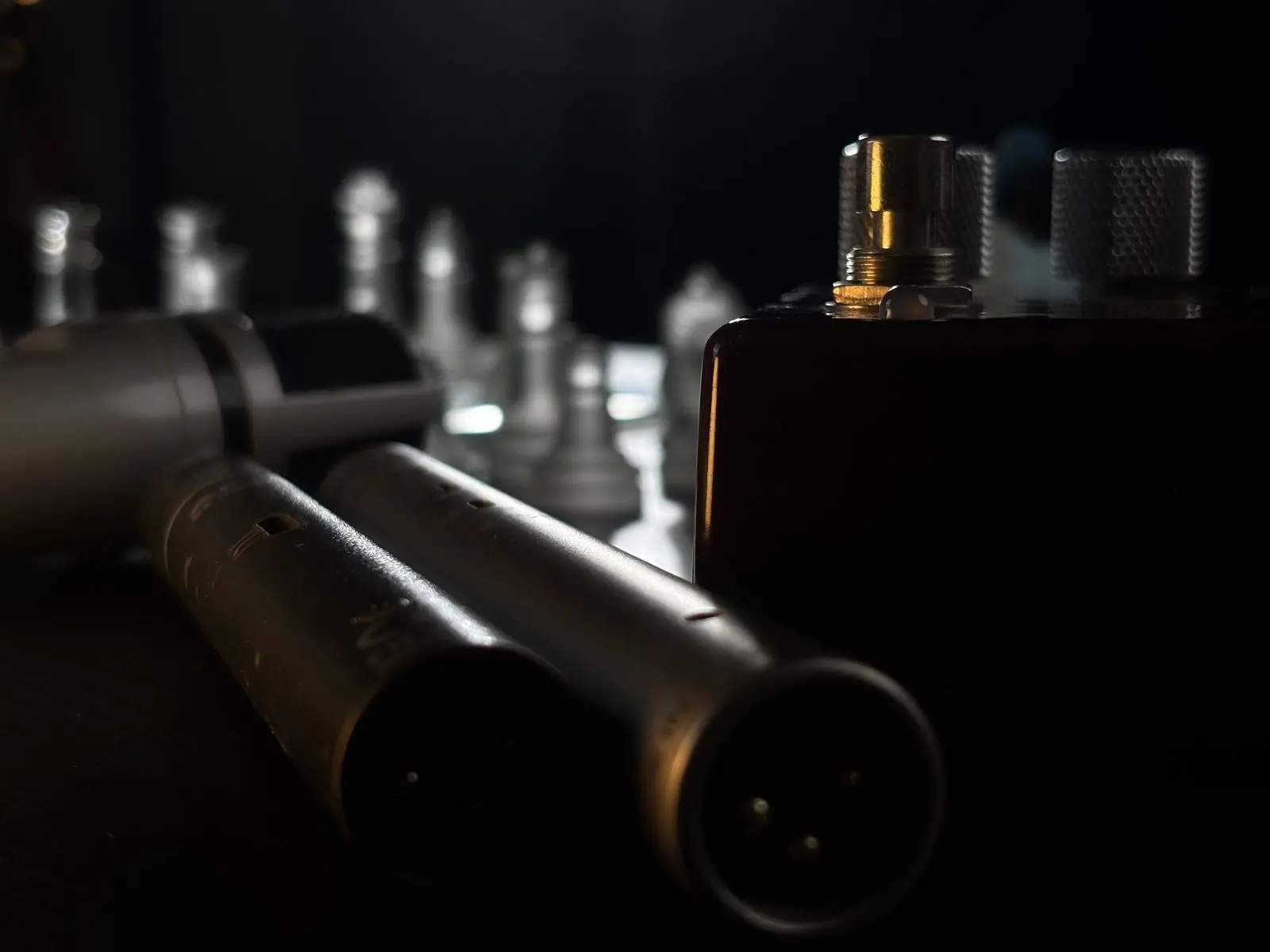
Multi-microphone setups
Useful separate inputs for the sources you need to balance, with placement and phase checked before recording.
The short version
What you get. Separate recordings that give the mix more control over the instrument, voice and room.
Is this for you? For a lesson where an instrument, a room and a voice have to be pulled apart afterwards, and the bleed currently welds them into one. A single voice to camera does not need this, and we will say so.
What leaves your plate. Input planning, placement advice and checks on the recordings, keeping the rig practical for the crew.
Start with the Free Audit.
Simple on set, separated in the mix
Where each of these microphones physically stands, against a particular room and a particular voice, is the microphone setup page; this one is about how many inputs there are and what separation each is there to buy the mix.
The rig on one teaching channel
For that teaching channel: two direct instrument inputs for stereo, two small-diaphragm condensers in the room and one close microphone for the voice. Each has a defined job; placement determines how independently the sources can be balanced.
Small enough for the crew to repeat
A rig that slows a room down creates a reason to skip it. We keep the setup practical enough to repeat, with each input earning its place in the mix.
Separation is what the mix is for
A single microphone gives one file in which the room, the instrument and the speaking are already fused. Software can pull a fused file partway apart now, but it rebuilds rather than recovers, which makes it a rescue and not a plan. Five gives three independent decisions when the placement earns them: depth on the playing, legibility on the teaching, and a room that can be widened or quietened without touching either. The choice is made once, on set, and it decides everything downstream.
The camera's own audio never reaches the master
Written into one partner's standard as an explicit no: use the file from the recording setup, never the sound the camera happened to capture. Camera audio is a sync reference and a safety net. Treating it as a source is how a beautifully lit lesson ends up sounding like a lesson recorded from the back of the room.
Five inputs, and what each is for
| Instrument | two, stereo, direct |
|---|---|
| Room | two small-diaphragm condensers, at distance |
| Teaching voice | one close voiceover microphone |
| Camera audio | sync reference only |
| Balanced afterwards | room, instrument and voice, independently |
The cost of every extra input
Why more microphones is not a better answer
Every extra input adds a path to the same source, another arrival time, another chance for two captures to fight. Beyond a point the noise floor rises, the phase relationships multiply and the setup time starts eating the shoot. The useful question is never how many, it is what each one is there to give the mix.
What placement is deciding
How much room comes with the instrument. How much instrument comes with the voice. How much of the recording can be cleaned later, and how much of it is already committed. Close buys clarity and buys plosives with it; distance buys the space and buys reflections with it. All of that is settled before anyone presses record.
The rig has to survive the room it is in
Ceiling height, floor covering, the lid of an instrument, a window, a fan. A setup designed on paper for a treated studio behaves differently in a rented rehearsal room with daylight coming in, so the design is confirmed against the first files that come back.
At the bench
The work, demonstrated
Try a decision from the craft: drag, tap or toggle, then read the trade-off.
These are illustrative models; no partner’s results are shown.
More demonstrations at the bench →Keep the microphone count low, and still deliver the warmth of a proper studio capture to somebody listening through a tablet plugged into a living-room system.
The design brief, in Dogu's own framing; he hears a fridge two rooms away.
What changes for you
More control over the balance of instrument, voice and room, from a setup designed to be repeated by your crew.
Related: Phase alignment · Microphone setup · Audio mixing · Noise removal
Send recent videos. We will listen for the main audio problems and suggest what to address first.
Request your Free Audit.
Three fields, and a written reading back.
Your audit usually arrives within three working days. We use your details only to reply to your enquiry.
What you will get
What is working, what could improve and whether we can help.
Two or three priorities, with the reason for each.
A recommended next step, even if that step is not us.
There is no obligation to continue. We only arrange a call if you ask for one.
The work, written up
The case studies keep their dates, sources and limits visible.
See the casework →