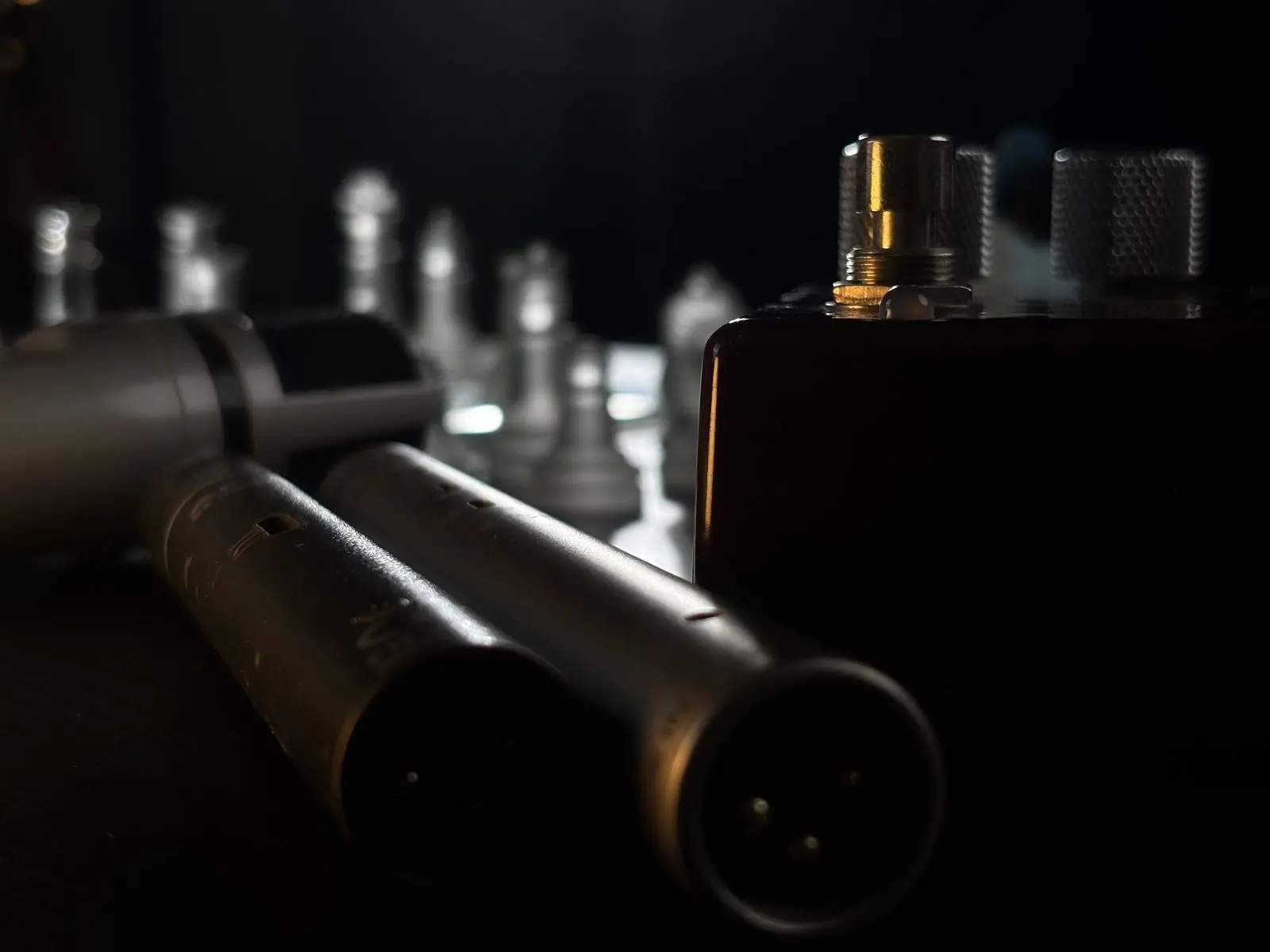
Phase alignment
Checked before a single fader moves, because timing between correlated microphones shapes a sound most people feel and almost nobody can name.
The short version
What you get. Multiple captures checked together, so avoidable timing or polarity problems do not undermine the mix.
Is this for you? For the voice that sounds hollow, where two microphones on one source are quietly cancelling each other. With a single microphone there is nothing here to fix.
What leaves your plate. Timing and polarity checks, corrective alignment where appropriate and rechecks when sources change.
Start with the Free Audit.
A millisecond has a sound
Alignment comes before balance
Nothing else in the mix is worth doing while two microphones meant to agree are fighting. Balance a misaligned pair and the balance is a compromise between two versions of the same sound cancelling each other, so every subsequent decision is made against a moving target. Phase gets checked first, every time, on every source that has a second, redundant capture close to it. A deliberately spaced pair, a stereo technique or a distant room microphone is the opposite case: there the timing difference is the point, it carries width and depth, and it is judged by ear rather than aligned away.
The frequencies that thin out
Two microphones at different distances receive a source at different times. When their signals are combined, that relationship can reinforce some frequencies and reduce others. We listen for unwanted thinning while preserving timing differences that create useful space.
Build the check into the process
Capture and post-production are planned together, with phase checks recorded in the workflow. A clear process makes the check repeatable; it still needs someone to listen and judge the result.
It is the first thing checked and the last thing trusted
Alignment gets rechecked after anything that could disturb it: a new take, a replaced source, a re-synced angle, a plugin with latency it did not declare. The correlation meter is watched throughout rather than ticked off at the start, because a mix that was in phase before those changes is not automatically in phase after them.
Why two microphones disagree, and what settles it
Where the problem comes from
Distance, mostly. Sound travels at a fixed speed, so two microphones at different distances from one source are always slightly out of step, and the mismatch changes with frequency instead of sitting still. Then there is polarity, flipped by a miswired cable or a reversed input, which is a different fault with a similar symptom and a much faster fix.
How it gets treated
Correlation checked across every pair. Sample-level alignment where the fault is a delay, polarity inversion where it is a flip, and a decision about which capture holds the truth so the others move towards it and nothing drifts towards the middle. Where the recording cannot be saved this way, the answer is a retake, and it gets said.
The rule of thumb behind all of it
We correct timing differences when they weaken captures intended to reinforce each other. Deliberate spacing, such as a stereo pair or room capture, may carry useful width and depth. The recording and its purpose decide what to align and what to keep. Read more: microphone setup →
At the bench
The work, demonstrated
Try a decision from the craft: drag, tap or toggle, then read the trade-off.
These are illustrative models; no partner’s results are shown.
More demonstrations at the bench →With this setup there is no fear of an editor who would not notice, because every millisecond counts and the design assumes somebody is listening for them.
The founder, on why the rig was designed the way it was.
What changes for you
A more dependable starting point for the mix, with unwanted cancellation addressed and deliberate space preserved.
Related: Multi-microphone setups · Audio mixing · Audio post-production · Noise removal
Send recent videos. We will listen for the main audio problems and suggest what to address first.
Request your Free Audit.
Three fields, and a written reading back.
Your audit usually arrives within three working days. We use your details only to reply to your enquiry.
What you will get
What is working, what could improve and whether we can help.
Two or three priorities, with the reason for each.
A recommended next step, even if that step is not us.
There is no obligation to continue. We only arrange a call if you ask for one.
The work, written up
The case studies keep their dates, sources and limits visible.
See the casework →